HIGHLIGHTS
•
Solid lubricants are required to minimize the formation of particle networks that may result in agglomeration during the planting of seeds.
•
A suitable seed lubricant was developed based on modification of cellulose fiber with an alkylsilane.
•
The newly developed, biodegradable solid seed lubricant exhibited five times better performance than commercial talc lubricants and was 25 times better than polyethylene microplastics in testing using a commercial planter.
Developing lubricants that provide both excellent performance and good biodegradability is becoming a goal of researchers as customers are seeking both characteristics. Various types of biodegradable lubricants have been available for a long period of time, but those derived directly from vegetable oils have exhibited poor performance particularly from the oxidation standpoint.
Efforts to develop biodegradable lubricants and renewable fuels have involved evaluating a number of nonfood crops that can be readily grown. In a previous TLT article,
1 researchers reported the synthesis of a liquid known as bio-oil through pyrolysis of a crop such as switchgrass. This process takes place at 500°C under a nitrogen sparge. At least 60% of the resulting mixture is bio-oil, which was separated from other components. The goal of this approach is to evaluate the bio-oil as a fuel, enable farmers to produce it onsite during a harvest and use it in their tractors.
In modern agriculture, productivity is becoming very important from the time seeds are planted to when crops are harvested. Martin Thuo, professor in the materials science and engineering department at North Carolina State University in Raleigh, N.C., says, “Farming is not a high margin business so improving efficiency is critical starting with planting seeds. Farmers move their mobile equipment at speeds between 11 and 16 kilometers per hour and plant tens of seeds per second into the soil. With the high rate of planting, a good understanding of solid particle flow is required.”
The seeds used vary by crop and have different shapes and coatings making it difficult to systematically develop planting procedures. Thuo says, “Unfortunately, there is a poor understanding of how granular particles with complex shapes and surface attributes flow from the hopper into the ground. Current theories were devised under the assumption that all particles are perfect spheres with smooth surfaces and point contacts. This is not the case with agricultural grains which are non-ideal particles.”
The problem farmers face is that complex interactions among solid particle seeds can lead to the formation of particle networks that may result in agglomeration and eventually limiting free movement due to jamming. Solid lubricants are added to seeds during planting to minimize these issues and enhance continuous seed flow. In effect, these lubricants act to disrupt particle clustering.
Thuo says, “The currently used seed lubricants are talc and microplastic polyethylene particles. Both are toxic to humans and the environment. Talc powder was found to cause health risks due to potential asbestos contamination while polyethylene microplastics are prevalent in waterways causing health issues to aquatic animals and humans.”
A more desirable seed lubricant, preferentially derived from a renewable source, is needed as an alternative. Thuo and his colleagues have now developed a viable option that is bioderived.
 Cellulose fiber
Cellulose fiber is a suitable seed lubricant after its surface is modified with an alkylsilane. Thuo says, “We prepared the cellulosic fibers from softwood pulp and mechanically homogenized them. Each of the fibers is 0.2-2.0 millimeters in length and 10-15 microns across. The complexity of the planting process means that these fibers cannot just be evaluated based on friction. Rolling friction is a factor but so are packing ratio, adhesion, surface interactions and moisture. The presence of adsorbed moisture on seed surfaces makes it essential to include an alkylsilane coating, which makes the seed lubricant hydrophobic, hence repel water.”
The seed lubricant has the appearance of a powder. Four images are shown in Figure 1.
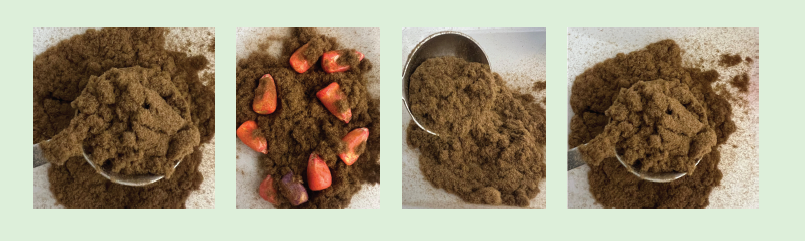 Figure 1. A newly developed biodegradable seed lubricant is a powder that is demonstrating promise in minimizing problems that can be encountered by farmers in planting. Figure courtesy of North Carolina State University.
Mechanical friction is reduced by the alkylsilane modified cellulosic fiber because the solid lubricant slips between the seeds and reduces rubbing. The hydrophobic nature of the coated cellulosic fiber produces a slippery surface that facilitates seed movement through the hopper without jamming and clustering.
Initial lab testing was conducted using smaller diameter seeds such as mustard that have very rough surfaces making them more likely to jam during planting. Network analysis and rheological data indicate that the introduction of the alkylsilane modified cellulosic fiber significantly improves seed flow.
A stationary seed meter and a commercial planter were then used to evaluate the alkylsilane modified cellulose fiber on a variety of seeds including two (soybean and corn) that are too big to evaluate in the lab. Thuo says, “Our biodegradable solid lubricant displayed at least five times better performance than commercial talc lubricants and was 25 times better than polyethylene microplastics. We also observed better performance with smaller seeds such as mustard and canola and under high humidity conditions.”
The biodegradability of the alkylsilane modified cellulose fiber was determined by placing this material in a transparent planting pot containing compositing worms. After 10 days, the pot containing worms was completely degraded while a control with no worms showed much slower degradation.
Future work will involve development of a seed lubricant that displays zero release into the environment. Thuo explains, “While the alkylsilane modified cellulose fiber has a 20% release into the air which is much better than talc (80%), we are still working to fine tune the seed lubricant to eliminate any environmental exposure.”
Additional information on the biodegradable solid seed lubricant can be found in a recent article
2 or by contacting Thuo at mthuo@ncsu.edu.
REFERENCES
1.
Canter, N. (2013), “Production of bio-oil,” TLT, 69 (4), pp 10-11. Available at www.stle.org/files/TLTArchives/2013/04_April/Tech_Beat_I.aspx.
2.
Jamadgni, D., Gergory, P., Xiao, X., Martin, A., Kiptoo, D., Jones, A., Nguyen, K., Banerjee, S., Visheratina, A., Muyanja, N., Chang, B., Bogdan, P., Kotov, N. and Thuo, M. (2025), “Graph theory-based bio-derived solid lubricant,” Matter, 9, 102474.