Symbolic-Regression Based Extended Hertz Theory for Coated Bodies
By Brian C. Delaney, Shuangbiao Liu and Q. Jane Wang | TLT Fellowship Research February 2026
Department of Mechanical Engineering, Northwestern University, 2145 Sheridan Road, Evanson IL 60208
Editor’s Note: This month TLT profiles the 2025 recipient of The Elmer E. Klaus Fellowship, Brian Delaney (Northwestern University). The Klaus Fellowship, along with The E. Richard Booser Scholarship, are awarded annually to graduate and undergraduate students, respectively, who have an interest in pursuing a career in tribology. As a requirement for receiving an STLE scholarship, students are given the opportunity to participate in a tribology research project and to submit a report summarizing their research. For more information on the Elmer E. Klaus Fellowship, visit www.stle.org.
Brian Delaney received his degree in mechanical engineering from Rensselaer Polytechnic Institute. He is currently a doctoral student at Northwestern University working in the Center for Surface Engineering and Tribology under the leadership of Dr. Q. Jane Wang. He has previously been awarded the National Science Foundation’s Graduate Research Fellowship for his work applying artificial intelligence to the field of tribology. His doctoral research focuses on utilizing state-of-the-art machine learning practices to make tribological data FAIR and to fuse data-driven and theoretical practices for improved wear modeling. Delaney can be reached at briandelaney2028@u.northwestern.edu.
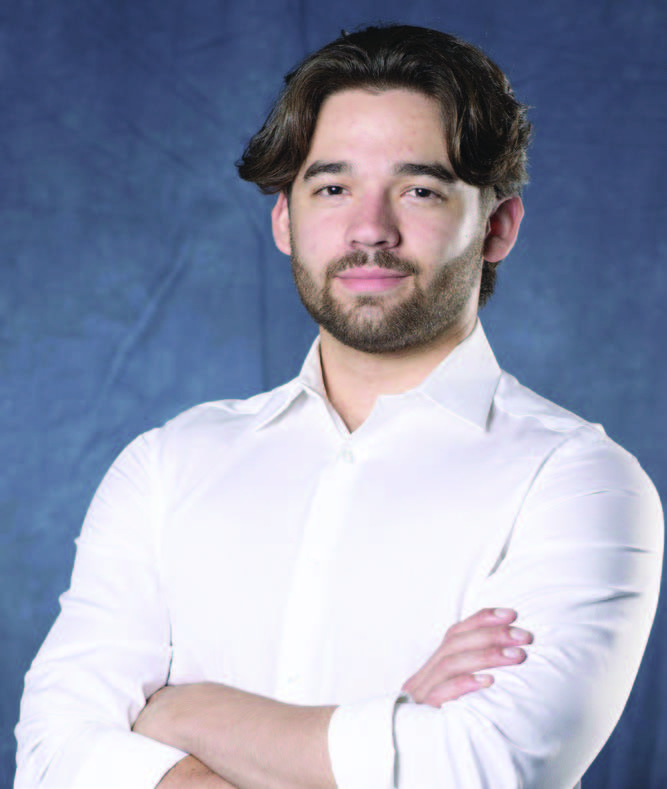
Brian Delaney
Abstract
This works presents a symbolic regression (SR) approach to model contact mechanics of spherical, coated bodies, extending the classical Hertz theory using data generated via discrete fast-Fourier transformation-based simulation. The SR models, learned via QLattice, produce closed-form expressions for normalized (with respect to results for the substrate alone) contact radius, peak Hertzian pressure, and contact approach as functions of nondimensional modified modulus ratios between coating and substrate and nondimensional coating thickness. By embedding physical constraints into the model structure, the approach enforces known physical constraints and ensures interpretability. The learned expressions achieve near perfect R2 scores and less than 0.2% mean absolute percentage error across all contact characteristics in the training data and exhibit strong interpolation and extrapolation performance. The application domain is then extended to elastic indenters via the Hertz theory and achieves under 1% mean absolute percentage error in predicting contact characteristics for an elastic indenter on a coated body. Unlike black-box methods, SR retains analytical transparency, offering both predictive power and physical insight. This study highlights SR’s potential as a bridge between data-driven modeling and mechanics-based understanding in tribology; it also includes an examination on the use of the spring-in-series for model extension.
Read the full article in the digital TLT.