During the late 2010s when a lot of research dollars were poured in battery chemistry development to improve battery range before recharging, the idea of solid-state battery technology started getting a lot of attention. One of the main reasons was to improve safety of lithium-ion batteries because of a few incidents of vehicles catching fire. Formation of a dendrite-like structure on anode surface from multiple cycles of charging and discharging can grow long enough to cause a short circuit, overheating and ultimately fire. A solid-state battery is also an electrochemical cell technology similar to lithium-ion batteries, but it utilizes a solid electrolyte instead of a liquid one, as shown schematically in Figure 1. The other advantages of solid-state batteries are:
1
1.
Higher energy density: Solid-state batteries can store more energy in the same volume, potentially leading to longer-range electric vehicles (EVs) and/or more compact and lighter battery packs.
2.
Faster charging: The solid electrolyte can facilitate faster ion movement, leading to significantly quicker charging times compared to liquid electrolyte batteries.
3.
Enhanced safety: Solid-state batteries are less prone to catching fire or exploding due to the non-flammable nature of the solid electrolyte, reducing the risk of thermal runaway. This is probably one of the most attractive features of this technology.
4.
Improved temperature performance: They can operate effectively in a wider range of temperatures, including both hot and cold environments, without significant performance degradation. This is a significant advantage over lithium-ion batteries.
5.
Reduced need for thermal management: Solid-state batteries may require less complex and costly thermal management systems compared to traditional lithium-ion batteries.
6.
Potential for reduced manufacturing costs: While initial production costs may be higher, solid-state batteries have the potential to be more cost-effective in the long run due to their higher energy density and potentially longer lifespan.
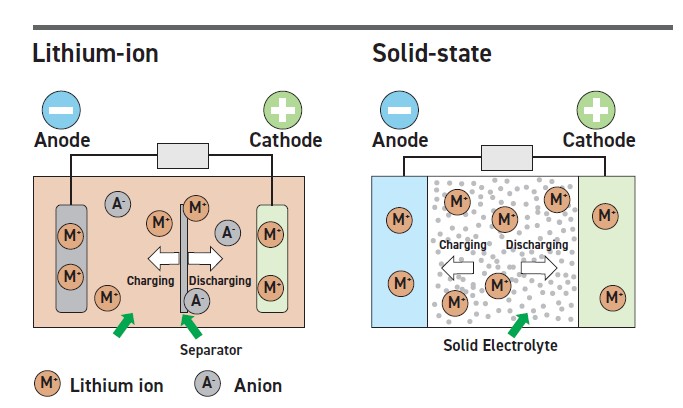 Figure 1. Schematic of a conventional lithium-ion battery (left) and a solid-state lithium-ion battery (right).
However, there are technical and manufacturing challenges. Technical challenges include lower ionic conductivity compared to liquid electrolytes in traditional lithium-ion batteries, resulting in a lower number of ions passing through in a given time, thereby affecting the capacity of the battery. Chemical stability of electrolytes is another challenge. Many materials are either chemically unstable or prone to degradation over time, especially at the electrode interfaces. Solid electrolytes have a smaller contact area with electrodes than liquid electrolytes and form empty spaces named as voids, which act as resistance and reduce the battery performance.
2 Swelling of the battery during charging and, ultimately, the degradation of the cell after extensive recharging is also an issue. Manufacturing challenges include higher cost of materials, which can make this technology less competitive than lithium-ion batteries. Some solid electrolytes, particularly ceramic-based ones, are brittle and can crack or fracture during manufacturing or under stress, leading to battery failure. Also, production of such batteries requires specialized equipment and facilities necessitating investment.
Intense research, engineering development and tests are underway to bring solid-state battery technology in EVs with improved performance, reduced costs and scaled up manufacturing. Most of the automotive companies are currently working with battery manufacturers on demonstrating solid-state batteries in vehicles, with some aiming for production by 2027-2028. The concept of a semi solid battery, which is a hybrid design of solid electrolyte and liquid electrolyte, is also being pursued, mostly in China as an interim solution.
3
REFERENCES
1.
www.quantumscape.com/technology/
2.
Park, S. S., Han, S. A., Chaudhary, R., Suh, J. H., Moon, J., Park, M. and Kim, J. H. (2023), “Solid electrolyte: Strategies to address the safety of all solid-state batteries,”
Advanced Energy and Sustainability Research, 4, 2300074.
3.
www.cnbc.com/2024/10/16/the-race-for-next-gen-ev-batteries-may-soon-pivot-to-semi-solid-state.html#:~:text=A%20sign%20is%20displayed%20outside,%2C%202024%20in%20Tokyo%2C%20Japan.&text=Japan's%20Toyota%2C%20for%20instance%2C%20has,speed%20of%20the%20charging%20point
Dr. Arup Gangopadhyay is retired from Ford Motor Co. and is based in Novi, Mich. You can reach him at arup.gangopadhyay@sbcglobal.net.