Another case of friction and a plane crash
By R. David Whitby, Contributing Editor | TLT Worldwide January 2026
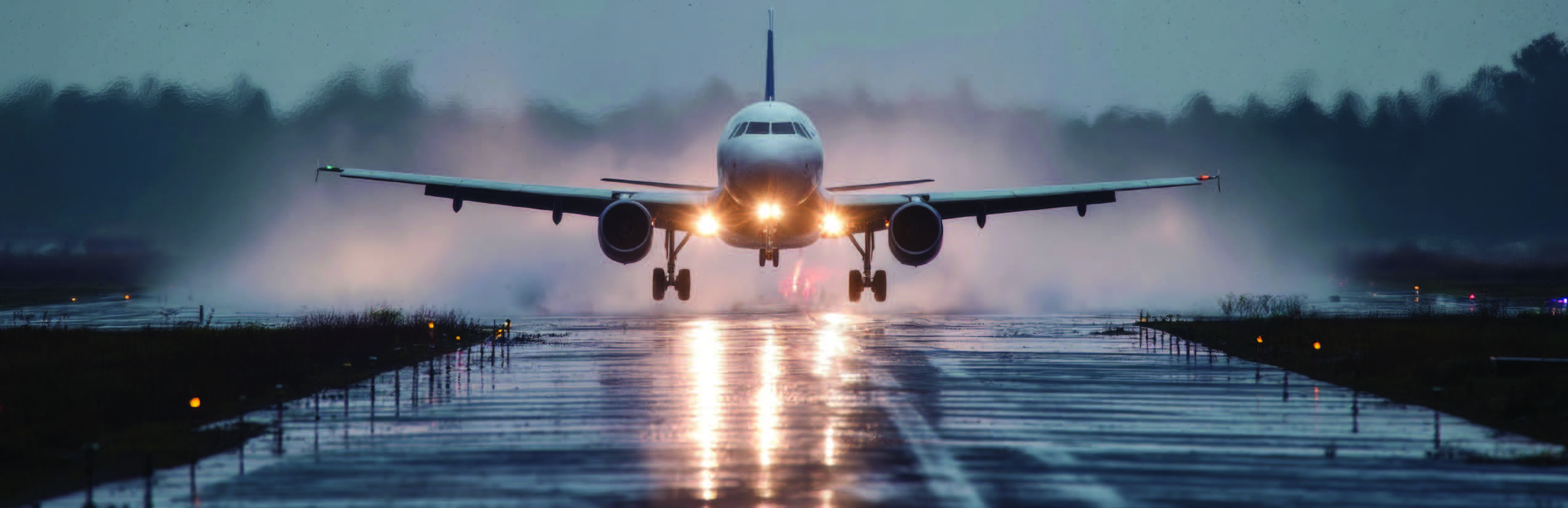
Reverted rubber hydroplaning was made worse by a lack of grooves in the runway surface.
In March last year I wrote about the consequences of friction and wear leading to the fatal crash of a commuter aircraft. I recently came across another example of friction causing the crash of an aircraft, while I was watching an episode of “Air Crash Investigation,” first broadcast on the National Geographic Channel on Feb. 10, 2016.
Atlantic Airways Flight 670 overran the runway at Stord Airport, Sørstokken, Norway, on Oct. 10, 2006, fell down the steep cliff at the end of the runway at slow speed and burst into flames, killing four of 16 people on board.
Flight 670 was a regular, chartered return flight for Aker Kvearner to take its employees to and from Stavanger Airport, Sola and Stord Airport, Sørstokken, to Molde Airport, Årø, in Norway. The British Aerospace 146 aircraft departed Sola at 7:15, with 12 passengers and a crew of four. The captain, 34-year-old Niklas Djurhuus, was flying the plane, while the first officer, 38-year-old Jakob Evald, was the pilot monitoring.
The BAe 146 has four geared turbofan jet engines and is specifically designed for short runway operations and for flat landings, where the main and nose landing gears touch down nearly simultaneously. It has powerful wheel-brakes and airbrakes with large spoilers to dump lift immediately on touchdown, but the engines do not have thrust reversers. The ground at both ends of the Sørstokken runway slope steeply downwards. The runway was damp at the time of the accident.
The aircraft touched down gently at 7:32, a few meters past the ideal landing point. The first officer called for deploying the spoilers and the captain did so half a second later. Two seconds later the first officer called “no spoilers” as the indicator light was not illuminated. He then observed the hydraulic pressure was normal and that the spoiler switch was set correctly. Meanwhile, the captain had switched the engines from flight idle to ground idle and activated the wheel brakes. A few seconds later screeching sounds could be heard from the landing gear. Braking took place nominally until halfway down the runway, but the pilots reported that nominal slowing did not occur. The captain attempted to use the brake pedals to apply full braking, without effect. He then moved the brake lever from green to amber and subsequently emergency brake, disconnecting the anti-lock braking. Witnesses observed smoke and spray coming from the landing gear.
By then, the aircraft had insufficient speed to abort the landing. Aware the aircraft would most likely overrun, the captain opted to not steer it off to the left where there was a steep descent, or to the right where there were rocks. As a last resort, he attempted to reduce speed by skidding the aircraft by first steering it right, and then sharply left. The aircraft overran the runway 22.8 seconds after touchdown.
The aircraft slid off the runway at an angle of about 45 degrees, 46 meters from the end of the runway and 50 meters above the sea. The middle section of the fuselage and the right wing caught fire, caused by a fuel leak ignited by a short circuit, and this spread to the fuel tanks. An ample supply of oxygen was provided by an engine still running, even though the pilots had shut off the fuel to the engines. Evacuation of the aircraft was made more difficult because two of the doors were jammed shut by the force of the impact.
The Accident Investigation Board Norway (AIBN) was unable to find the underlying cause of the spoiler malfunction. However, when the captain selected emergency braking, thereby disabling the anti-lock braking system causing the brakes to completely lock, this resulted in reverted rubber hydroplaning. This is a condition in which the tires become extremely hot due to friction against the runway surface and the water on the damp surface evaporates, effectively causing the tires to float on a cushion of steam over the runway surface, greatly reducing braking. This situation was made worse by a lack of grooves in the runway surface and the aircraft simply ran out of runway.
David Whitby is chief executive of Pathmaster Marketing Ltd. In Surrey, England. You can reach him at pathmaster.marketing@yahoo.co.uk.