•
A process has been proposed to remove carbon dioxide from biomass through the production of bio-oil that can be used to plug abandoned oil and gas wells.
•
Establishing a network of small-scale pyrolysis biorefineries on farms will be needed to produce the bio-oil from readily available feedstocks such as corn stover.
•
If a sufficient number of biorefineries are used, a life-cycle analysis indicates that bio-oil well injection will remove between 1.7 and 2.1 kilograms of carbon dioxide per kilogram of oil.
Research is continuing to find cost effective approaches for removing greenhouse gases from the environment. Direct air capture has emerged as a viable technology for removing carbon dioxide from the air. This technology involves passing air across a solid sorbent or filter to extract the carbon dioxide.
Finding a cost-effective method has proven challenging because the concentration of carbon dioxide in air is low, diffusion of carbon dioxide is slow and the kinetics of the process are limited. In a previous TLT article,
1 researchers proposed using a type of sorbent that takes advantage of differences in water concentration in the environment (known as moisture-swing). During the day, conditions are favorable for capturing carbon dioxide due to low humidity. But at night, the humidity is higher leading to better conditions for releasing hydrogen. A copolymer matrix was employed as an anion-exchange resin with various anions to assess the effectiveness of capturing carbon dioxide. Polyvalent anions displayed the best performance in this study.
Another source of carbon dioxide is in the biomass present in the environment that is either a by-product of crop production such as corn stovers or forest debris. Dr. Mark Mba Wright, professor of mechanical engineering at Iowa State University in Ames, Iowa, says, “Biomass is an attractive raw material to be derivatized for carbon removal because it is abundant, inexpensive and can be accessed in different regions of the U.S.”
While biomass contains a high level of carbon, a derivative must be found and a location identified where it can be stored for a long period of time. Wright says, “Bio-oil is a derivative of biomass that has the potential for meeting the storage requirement. Fast pyrolysis can be used to readily convert biomass to bio-oil by in a few seconds upon exposure to high temperature (above 500℃) for a matter of seconds in the absence of oxygen.”
A previous TLT article
2 highlighted past research done to develop a fast pyrolysis procedure that can generate higher levels of liquid. Treatment of different biofeedstocks at temperatures of 500℃ under a nitrogen sparge produced 60% to 70% bio-oil plus lower concentrations of biochar, and synthesis gas.
Wright says, “The process of converting biomass to bio-oil and then storing it is known as Biomass Carbon Removal and Storage (BiCRS).” A new study3 has just been published that discusses the commercial feasibility of implementing BiCRS.
Small-scale pyrolysis biorefineries
The researchers proposed a novel carbon removal pathway using fast pyrolysis and determined that this approach is economically feasible by following up with a techno-economic analysis, and life-cycle assessment (LCA). Wright says, “Our strategy is not just to remove carbon dioxide from biomass but to also use the resulting bio-oil to plug the estimated 310,000 to 800,000 abandoned oil and gas wells in the U.S. This plan has an additional benefit because abandoned oil and gas wells emit a significant amount of the greenhouse gas, methane. Plugging them will also be part of this sustainable process.”
A key element of the strategy is to establish a network of small-scale pyrolysis biorefineries throughout the U.S. Wright explains, “We are proposing to build and deploy a network of biorefineries that can produce from five to 200 metric tons of bio-oil on a daily basis. As an example, we in the U.S. state of Iowa have a large concentration of farms producing corn. Once this crop is harvested, corn stover (stalks, leaves, husks and hobs) from the plants are left as waste on the field. Farmers will eventually collect the corn stover and place this by-product in a silo
(see Figure 4). Placement of a small-scale pyrolysis biorefinery at the farm will facilitate the immediate production of bio-oil. Farmers will also benefit from an additional source of income.”
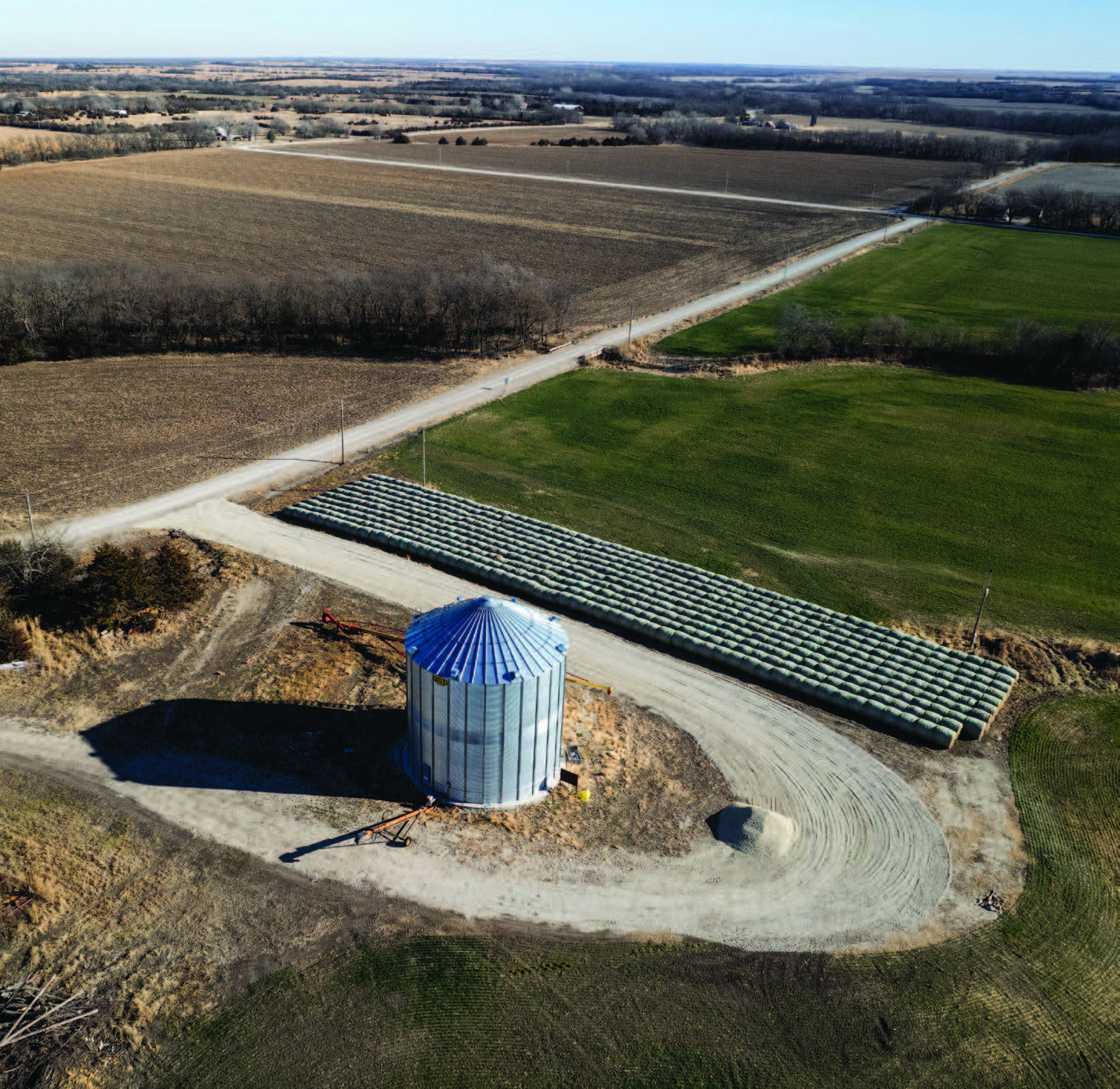 Figure 4. Farmers will be expected to store by-products of harvesting in silos to be used as raw materials for the production of bio-oil that can be used to plug abandoned oil and gas wells. Figure courtesy of Iowa State University.
Once the bio-oil is collected, Wright envisions it will be transported to centralized locations to be stored until used to plug oil and gas wells. Plugging wells will be challenging as the average one will require more than 800,000 liters of bio-oil.
Besides corn stover, the researchers also evaluated other biomass including clean pine, tulip popular, hybrid poplar and switch grass. Wright says, “We chose these feedstocks because the represent the most common biomass considered for bioenergy production.”
The challenge in implementing this strategy is not every biomass exhibits characteristics favorable for bio-oil production. Wright says, “Corn stover is an example of biomass that contains a high ash content which can have an undesirable catalytic effect to reduce bio-oil product yield. Woody biomass has a lower ash content making it more suitable for fast pyrolysis. But the trade-off is that woody biomass is also more expensive.”
The techno-economic analysis indicates that utilization of small-scale biorefineries is economically viable as long as a sufficient number are operational. Wright says, “We calculated that the cost for carbon dioxide removal is $200-$300/ton which is compatible with direct air capture. We will need to set-up thousands of pyrolysis units to reduce the cost of carbon dioxide removal to $160/ton.”
Life-cycle analysis indicates that bio-oil well injection will remove between 1.7 to 2.1 kilograms of carbon dioxide per kilogram of oil. Net carbon footprints are estimated to range from -0.62 to -1.55 kilograms of carbon dioxide per kilogram of oil. Feedstock selection is important in achieving maximum carbon dioxide removal with woody feedstocks displaying better results than switchgrass.
Wright says, “We are working with a commercial partner to implement the conversion of biomass to bio-oil and use it to plug oil and gas wells. Figure 5 shows an industrial pyrolysis unit processing biomass bales.”
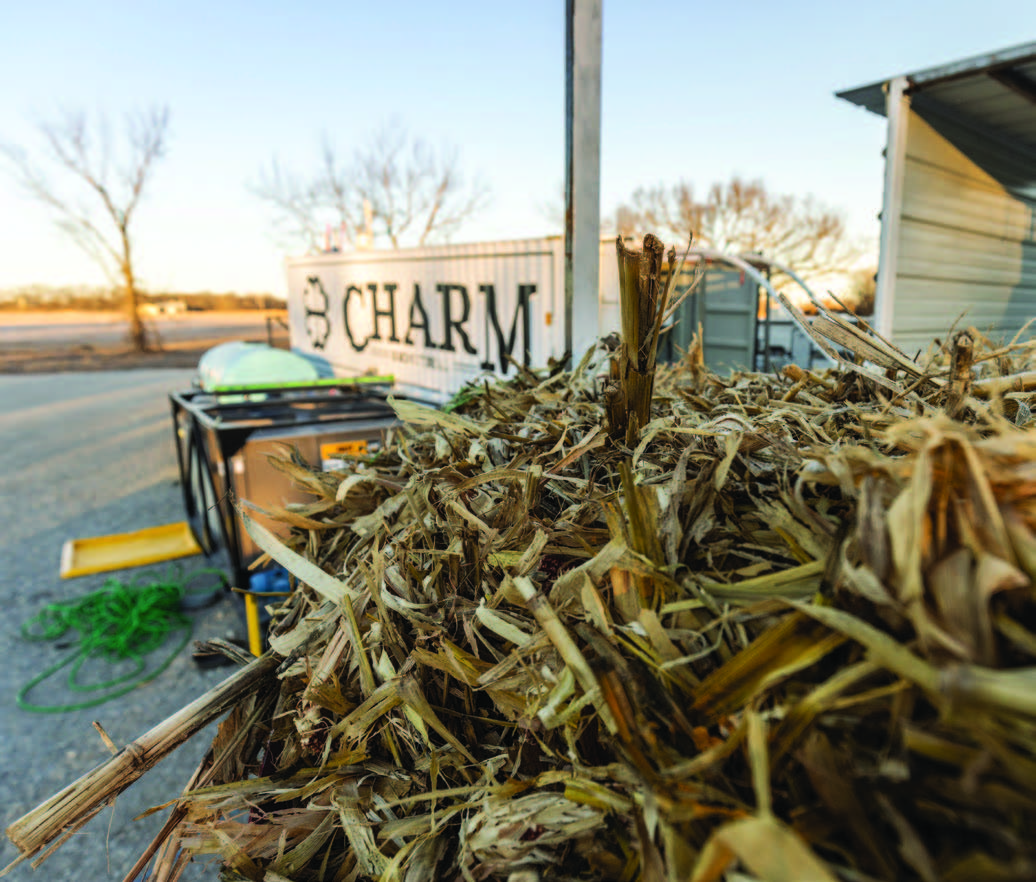 Figure 5. On-site production of bio-oil at farms can be conducted using an industrial pyrolysis unit that is processing biomass bales. Figure courtesy of Iowa State University.
Additional information can be found in the recently published study
3 or by contacting Wright at markmw@iastate.edu.
REFERENCES
1.
Canter, N. (2024), “Direct air carbon capture,” TLT,
80 (3), pp. 18-19. Available at
www.stle.org/files/TLTArchives/2024/03_March/Tech_Beat_III.aspx.
2.
Canter, N. (2013), “Production of bio-oil,” TLT,
69 (4), pp, 10-11. Available at
www.stle.org/files/TLTArchives/2013/04_April/Tech_Beat_I.aspx.
3.
Dubey, P., Gnangbe, S., Wright, M. (2025), “Enhancing carbon removal via scalable on-site pyrolysis and well-plugging systems,”
Energy Conversion and Management, 341, 119980.